[00:00:00] Speaker A: Foreign.
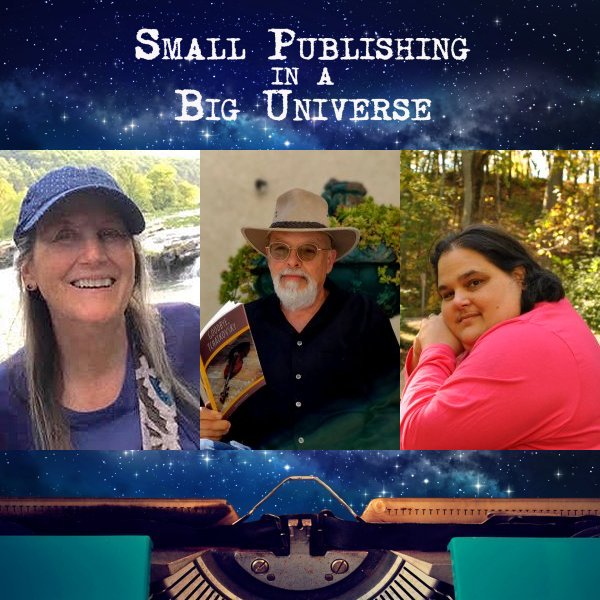
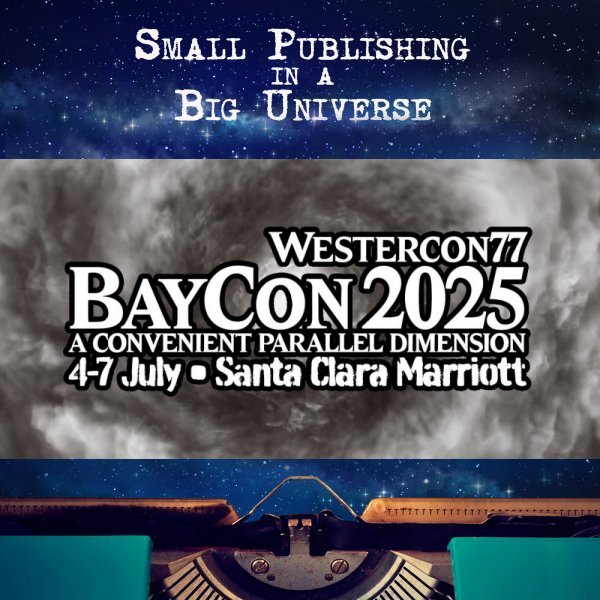
[00:00:08] Speaker B: Welcome to small publishing in a big universe. I am your host, Lisa Jacob. This month we have interviews from Bacon 2025 in a two part episode coming out this month from Water Dragon Publishing, A Familiar Problem by Stephen D. Breuer From Paper Angel Press, Fault Faultless by the California Writers Club, San Francisco Peninsula Chapter. And from Graveside Press, Pareidolia by Demir Salkovic.
A Familiar Problem by Stephen D. Breuer. When a young teenage boy is summoned by a demon to become a familiar to that demon, neither of them are aware of the repercussions.
A Familiar Problem by Stephen D. Brewer is available by Kobo, Smashwords and Amazon and other online booksellers. Or support your local bookstores by contacting bookshop.org.
[00:01:28] Speaker C: This is live from Baycon 2025. I'm your guest host, Brian Ce Buhl.
[00:01:33] Speaker D: And I have with me Katie Fitzgerald.
[00:01:36] Speaker C: Hi Katie. So tell me a little bit about your books.
[00:01:38] Speaker D: These are books that I conceived of when I was 13 and have been in my head ever since.
So it's epic fantasy, good people going through bad things, making good decisions, or at least the right decisions.
[00:01:52] Speaker C: Are any of your books out?
[00:01:54] Speaker D: My novella is out. My book, one in the series is coming out in September.
[00:01:58] Speaker C: What's the name of the book?
[00:01:59] Speaker D: The novella is in the Hands of Healers and the second book is the Healer's Heir.
[00:02:04] Speaker C: And you said that you conceived of this when you were 13 and this has just been a labor of love over time. Did you take a break from writing?
[00:02:11] Speaker D: Yeah, I've been away from fandom for about 20 years due to life, just circumstances and cleaning out the garage. And I found an old printout and I'm like, dang, this is actually pretty good. I should get back to this. So I picked it up a couple years ago and have been working on it ever since.
[00:02:26] Speaker C: What are some of the things that you've learned from revising older work?
[00:02:30] Speaker D: This is like the first six chapters of the Healer's era, which I actually wrote when I was in my 30s. Not when you're 13, not the high school version. The biggest thing I've learned is really the structure of the book.
I have a degree in English with a writing emphasis, but they never taught us story structure. It was just go write a story, come back and we'll all talk about it. So I've really been discovering which of the different story structure models that work best for me, how to incorporate that into my books and with the six chapters that I wrote initially, how to fold the structure into those chapters and Then continue the book from there.
[00:03:09] Speaker C: Have there been any resources that you've used to help you learn structure or has this been like through experience, trial and error? Like what sort of things? There may be some other writers that are looking at stories the way you have and maybe they want some kind of that guidance.
[00:03:23] Speaker D: There's a lot of structures out there. I looked at the Hero's Journey, which I know is very popular but made no sense internally to me. The one that I really clicked with was Save the Cat.
[00:03:34] Speaker C: Was there anything specifically, any kind of favorite that came out of Save the Cat for you?
[00:03:38] Speaker D: A lot of it was the build up. So you've got your inciting incident, you've got your mid story mess that needs to be focused and cleaned up. And then the thing that really crystallized for me was the all is lost beat and how to. I mean, because that's really where the story drives to before everything turns and starts resolving. All of those threads that you spun out need to start coming back in.
So that really crystallized the story form for me.
[00:04:09] Speaker C: Is there any favorite writing advice that you received that you like to share? Like if it's just one piece of advice.
[00:04:15] Speaker D: Oh my goodness, I don't know if there's one piece of advice that I received.
I think you have to figure out what works for you because what works for one person isn't going to work for another. I'm a discovery writer, which I didn't know until recently that there was such a, you know, a box yourself in. So I know my major goals that I need to hit. But how I get there is a mystery. Until I start writing.
[00:04:39] Speaker C: This has been really great. Is there anything else you would like to mention, talk about before we close?
[00:04:44] Speaker D: If people are interested, they can pick up a free download of in the Hands of Healers on my website and that's katifitzgeraldauthor.com and then my next book, the Healers Heir, is coming out in September and will be available on multiple platforms.
[00:04:59] Speaker C: Thank you so much.
[00:05:00] Speaker D: Thank you so much for promoting indie authors.
[00:05:03] Speaker A: I have with me Katherine Borst, usually going under the pen name Seaborst.
[00:05:07] Speaker C: Welcome to Bacon.
[00:05:09] Speaker A: Thank you. Glad to be here.
[00:05:10] Speaker C: You have a book out?
[00:05:11] Speaker A: I do, yes. Soldiers in Gray, title of the book. Yes.
[00:05:14] Speaker C: Well, tell me about Soldiers in Gray.
[00:05:16] Speaker A: So Soldiers in Gray is a story about a traumatized boy who's adopted by a soldier who tries to teach him to live happily in the civilized multiverse. Just focuses really on one of the worlds called Biblios, where there are librarians who love knowledge and books.
[00:05:33] Speaker C: Is this planned to be the first book in a series?
[00:05:36] Speaker A: Oh, that's a complicated question. I think it's planned to be one of the middle books in a series, but it should be perfectly fine to read by itself.
[00:05:43] Speaker C: What was your main inspiration for writing this story?
[00:05:46] Speaker A: So this story was actually somewhat of a mistake. I did not mean to write this story. What happened? I meant to write a different story that happens approximately 10 years after this story takes place in the same multiverse. And in that story, I ran into a problem where I really needed the main character of that novel to have a friend who would show up for him. And I was like, huh? What does this friend need to do? Who does this friend need to be? It's pretty crazy that this friend would show up in this way at the right moment. And then I got to thinking, well, okay, how did that happen? Who is this person? What is that backstory? Well, I'm just going to take a quick moment and write out a little bit of this person's backstory and see how that goes. And I enjoyed writing with Lewis so much and writing the story of how Lewis grows from being a really traumatized kid who won't speak to anybody into an actually competent adult who is going off and doing what he believes to be the right thing in the world. That I was like, this just needs to be its own novel. I'm doing it. One of the things I like to do, if I can when I'm reading somebody else's writing, is if I see something that's maybe not done so well, like, oh, this characterization wasn't good. I like to find another point where they did it so slightly better. Maybe they provided one detail here that was really great for the characterization. Hey, this is a great job, providing a vivid detail for this character that I think really informs how the reader sees the character. Can you do something similar in this other place? That's not always possible, but giving people more of a sense of where they should be going to, as well as the negative side.
[00:07:08] Speaker C: So you've brought up the editing, and you've learned a lot about how to be a better editor. Has it been through experience?
[00:07:17] Speaker A: Yes. I love reading. I love providing feedback, figuring out how to do it. Well, I actually asked for feedback on my editing so that I can become better at it.
[00:07:26] Speaker C: So, Soldiers in Graves, released in 2019. Are you working on something now?
[00:07:29] Speaker A: I am working on, unfortunately, three or four different stories right now, so it's going to be a little bit slower. I'm Hoping that I can finish them up closer to the same time and then have some release dates that are close together.
[00:07:40] Speaker C: And these are all self published or do you have a.
[00:07:41] Speaker A: So far, self published. I have not ruled out traditional or small publishing. I don't feel like I'm close enough to move in that direction yet. I want to be a little bit further in the text that I have written.
[00:07:51] Speaker C: Well, let's talk a little bit about your writing process.
So you did some world building in advance and then you came to the page. Do you primarily do a lot of plotting in advance or describe your writer? What's your writing process look like?
[00:08:02] Speaker A: So my writing process is to start with what really inspired me to write the story in the first place. And usually there's some key scenes along the way that I'm like, yes, this scene really needs to be in the book. Sort of like my keystone scenes. And I will go through and I will write those first and then I'll sit back after having done that. And that might be 20,000 words minimum, but completely disconnected. And they aren't, they aren't good scenes. They're just the basics of what needs to be in the scene so that I get a sense for what this is. And then I look at that and so based on this, how am I going to write the rest of the story around it so that there is the connective tissue, so that there is the appropriate build up to these cool scenes so that I'm not just dropping surprises on people that are completely unforeshadowed. That gets you to the first draft. And then I'm still working through how I do a good job editing.
[00:08:47] Speaker C: You don't write chronologically at the beginning. At some point do you shift to writing chronologically or do you continue to hop around?
[00:08:54] Speaker A: So I typically get those keystone scenes out non chronologically in just whatever order they feel most exciting to me. And then I will start at the beginning and write from the beginning through those keystone scenes to the end.
[00:09:05] Speaker C: How much do those keystone scenes change once you get to them? After going through chronologically?
[00:09:09] Speaker A: I have had to throw some out before. And they need a lot of work in terms of the setting because often I'm not focused on the setting. I'm focused on the action or the dialogue. Whatever's happening, I think they're still recognizable as the same scene. There's just more details in them. It took me three years to write Soldiers in Gray. It's a long time to stay excited about the same story. And so understanding what was exciting to me about the story and what I really wanted to continue having happen.
That was key to me maintaining focus on that story and being able to get there to the finish line.
[00:09:39] Speaker C: So what is your favorite advice?
[00:09:40] Speaker A: I think it is write the important parts. Because it's one of the mistakes I made, especially really early when I was writing in high school, is I'd write down all the tiny details that happened and it was too much. There just wasn't any plot there. But I thought that was what you were supposed to do. If you're writing the story, you've got to include all the bathroom breaks, which you do not have to do. I am not quite sure what gave me the idea that you ought to do that, but making sure that you understand what's important about what you're writing before you spend a lot of time writing it and then building on that, like, how do you know what's important? Figuring out how you know what's important is a key part of the process as well. I can't tell you how to know what's important. I know for me, I need to focus on what was that first exciting thing about the story. As I continue to develop as a writer, I'm learning more about how to figure out whether a scene is important to the story and how things fit into the pacing and then how the characterization works. Alongside all that I like to think that I have developed in the five years since 2019. There are many changes that I would make now to Soldiers in Gray if I were to rewrite it. That said, I'm happy with it as it is.
[00:10:46] Speaker C: This has been Kathryn Borst writing as Seaborst.
[00:10:49] Speaker A: Thank you so much for having me.
[00:10:50] Speaker E: I have with me Kim Smuggado.
[00:10:53] Speaker C: To begin with, let's talk about your book.
[00:10:55] Speaker E: I have written a portal fantasy, a humorous fantasy about a has been boy band that are magically transported to a fantasy world where they go on a D and D adventure. And it's called our comeback tour is Slaying Monsters.
[00:11:10] Speaker C: What were some of your inspirations for this story? Is there other portal fantasy that you read or is this something that just.
[00:11:16] Speaker E: Intrigued you a certain amount? But what happened was we were on a vacation that was very rainy and my teenage son pulled out the Crunchyroll and we started watching various series and he had a lot of issac highs. And I was watching one, I was thinking how come it's always this completely boring person that has nothing going for them in this world is pulled into the magical world to save the magical world. And so that got Me thinking about if your fantasy world is about ready to be destroyed, who would you pull out from the other world? And I was thinking, well, maybe military people or athletes or somebody that was already famous for some reason because they did something. And somehow or another that morphed into a has been boy band. And once I started digging into it, well, I could use this aspect and this aspect and this aspect. And the great thing about has been boy bands. A regular has been band. You're gonna have people that are 40 years old or so because they'll have their prime when they're in the 20s, maybe in the 30s, and then, you know. But a boy band hits their prime like 16, 17, so they're all 25 when they're washed up.
[00:12:15] Speaker C: This is the first book in a series?
[00:12:16] Speaker E: Yes. The actual series is called Boy Bands and Dragons.
[00:12:19] Speaker C: And this is your first series or. This is.
[00:12:20] Speaker E: This is my very first book.
[00:12:22] Speaker C: And when does it come out?
[00:12:23] Speaker E: It came out last year.
[00:12:24] Speaker C: They can find it on Amazon or.
[00:12:25] Speaker E: Yes, it's on Amazon. It's on Kindle Unlimited.
[00:12:27] Speaker C: What was your experience getting it published?
[00:12:30] Speaker E: I got a lot of rejections. This particular genre is kind of considered to be something that is more fan written or from a traditional publisher standpoint. There is so much Portal Fantasy and LitRPG, which is a sort of part of it, and this kind of like wacky sort of things that are being published independently.
So there's not really considered to be a place for it in the bookstores. After I couldn't find an agent, then I started going to small presses and I found a small press, a Riverfolk Press, and we're really interested in the book.
[00:12:58] Speaker D: So.
[00:12:58] Speaker C: So you have a podcast in which. Do you ever have guests on your podcast?
[00:13:03] Speaker E: Yes, we do. So I have a podcast which is a writing advice podcast. It's called Words to Write By. And our shtick is that we read writing craft books and then I am my podcast podcast partner, determine whether or not the advice is good or not or actually applies to us and we will read the entire book and we'll even do the exercises and all the stuff they say you should do with a writing craft book so can tell you for sure if it's good or not.
[00:13:25] Speaker C: Do you have any favorite craft books that have come out of that podcast?
[00:13:29] Speaker E: The most useful one was a book called Scene by Bickham. And it is a book that's all about how to make a page turner and how to write both the action scenes, how to make a scene early effective, and then how to make the sequel and the kind of people the thinking afterwards or how to make the whole book flow together so it's not just event, event, event, but it's like event. More contemplation, redirection, next event. That was dry, incredibly dry. It was almost bullet pointed and yet it was packed with information. And it had some really good writing exercises. We have done bird by bird because that's a great one. And then we did the Writer's Journey, which is a variation on the hero's journey. And that was a really hard one to get through, but it was great because we tackled the hero's journey and whether or not it actually applied to a lot of books. And there's always something useful in a craft book if you look hard enough. I would say that every book that we've done has had at least one aha moment for me of saying, oh, that's how that works.
[00:14:26] Speaker C: Is there a piece of favorite writing advice that you've picked up that is your favorite to share?
[00:14:31] Speaker E: I liked one by Anne Lamont that I always back to when I'm having a bad writing day where she had a 3 inch picture frame was her idea. And it was that you only had to write a very small amount every day and you could call it good. And I think so many writers beat themselves up because they can't write anything, but lowering expectations and meeting those expectations is a really good way to keep yourself writing.
[00:14:53] Speaker C: What's your take on AI tools? And how do you think that they can help or hinder creatives when they're trying to establish themselves as a writer?
[00:15:03] Speaker E: We decided to look at AI tools for writing because they were showing up everywhere. And the thing is that when they first came out two years ago, they sucked and everybody had a good laugh at it. And now they've gotten kind of scary good. So the question was, where is the human part of this? And a lot of writers will basically just say, I just won't use them at all. I'm not going to use them at all. It's not good writing. But I think we have to acknowledge that it's. It's not bad writing either in the sense that technically it works. The problem is that AI writing tools are coming and they're going to be out there and they're going to be available.
So the question is, if you just stand back and don't say anything about it, you don't involve yourself with them, then are you going to get left behind? Which is kind of always a little bit of fear. So what we did is we tested them. We tested them to see if they could generate ideas, if they could help us write better. And what we discovered is if you just ask an AI tool to write something, it's going to write what it wants and you're going to be out of the process. But if my writing partner is working on her memoir and she's a beautiful writer but sometimes she gets really lost and she's not necessarily sure where the chapter is going and she's learned to use the AI writing tools to analyze her writing and help her with what the themes are or to identify weaknesses in maybe the plotting. And she's then will look at the advice and then she'll incorporate it into her own writing. Like having a critique partner that's always there and available and isn't requiring you to read their stuff in return.
[00:16:28] Speaker C: What are you working on next?
[00:16:30] Speaker E: I'm working on the sequel to my book and I'm hoping that that will come out sometime next year. And then I'm also working on the podcast. We have website words to write by podcast.com or we're on the various platforms. I think that's also a really neat thing to check out as I'm so that's the other thing I actively work on is the the writing and the podcast.
[00:16:47] Speaker C: Thank you so much.
[00:16:48] Speaker B: Thank you.
[00:16:48] Speaker E: This is fantastic.
[00:16:50] Speaker B: Thanks again to our guest host, Brian C.E. buhl. Also thanks to our guests. If you want to know more about small Publishing in a Big Universe, visit our
[email protected] and subscribe to our newsletter. Send us your feedback by using the Contact Us link Like Us on Facebook @SPBUpodcast.
To find out more about the books and other products featured during this episode, please visit the Small Publishing in a Big Universe
[email protected] this podcast was recorded and edited by Lisa Jacob. Executive Producer is Stephen Radecki. Theme and ad music is provided by melodyloops. This month's episode was sponsored by Water Dragon Publishing, Paper Angel Press, Graveside Press, and Cupid's Arrow Publishing. You can listen to our podcast on Apple Podcasts, Spotify, Amazon Music, and most of your favorite podcast services.
Thank you very much for listening.