[00:00:00] Speaker A: Foreign.
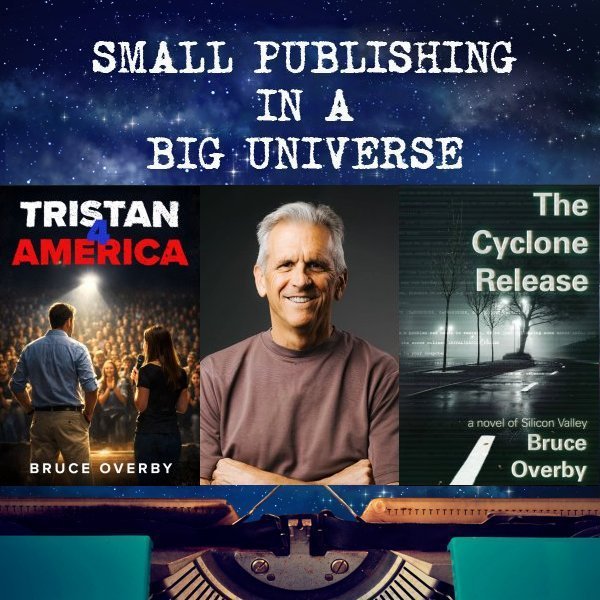
Hello and welcome to Small Publishing in a Big Universe. I am your host, Lisa Jacob. This month our interview is with author Bruce Overby from Cupid's Arrow Publishing. This month, Cheat Codes by Maura Ann Richardson Roses by Sally Kuntz from Water Dragon Publishing Slavery's Avatar by Andrea Montague Witchery by Fred Weiss.
Witchery by Fred Weiss A werebear has killed two people in their town, and Teyla, a young witch, leaves in pursuit, her first solo mission. Teyla's quest is sidetracked by Angus Kord. The two become lovers, and Teyla agrees to go with Angus to help in the battle against Maalek, the dark mage. But she discovers that her father, whom she thought was dead, is Malak's prisoner. As she attempts a rescue, Teyla finds herself face to face with the most powerful user of dark magic to ever exist. Witchery by Fred Weiss is available in digital editions, paperback and hardcover editions from Amazon, Barnes and Noble, Kobo, Smashwords, and other online booksellers, or support your local independent bookstore by ordering it through bookshop.org for more information, visit waterdragonpublishing.com.
This is Lisa Jacobs and we have with us today Bruce Overby. Thanks for taking the time out to do an interview with us.
[00:01:46] Speaker B: My pleasure, Lisa. Happy to be aboard.
[00:01:49] Speaker A: We have a few questions that we usually ask. The first one is what is your most recent book about?
[00:01:56] Speaker B: It's the story of Tristan Heller, a Silicon Valley sales operations executive who gets laid off during a pandemic and decides to run for president in the United States, taking along his mighty team from his Silicon Valley days onto the campaign trail where hijinks ensue.
[00:02:15] Speaker A: Why did you write this book and did you write this during the pandemic?
[00:02:20] Speaker B: I actually started this book in 2023. So you decide is that during the pandemic for some of still was. For some it wasn't et cetera. It was certainly in the wake of the pandemic. And the answer to why did I write this book? Is actually a really straightforward one. I was working on the sequel to my first novel, the Cyclone release, and I was not finding purchase. I was not really finding that story. And I did realize that the reason was that it was campaign season. The 2024 campaign had already sort of started to spin up and I am a little bit of a. Well, I am a big political junkie and I could not get the current state of American politics out of my mind enough to focus on that sequel. So I decided that I would just go ahead and write the story based on the tapes that were playing in my mind constantly and distracting me constantly from what I was trying to do, which was, of course, writing that sequel. And so I wrote this other book instead.
And so the voice of Tristan is very much the voice that was playing in my head during those early days, early days of the 24 campaign.
[00:03:35] Speaker C: So Tristan for number four
[00:03:37] Speaker A: America, seems to be a satire of the present political landscape. If he had been a real person, do you think he would have been elected president?
[00:03:48] Speaker B: That is a really interesting question. I specifically wrote a character who would not be elected president who had a very, very slim chance of even getting enough attention in the campaign. And that was specific to the story because I didn't want him to really be a serious contender. On the other hand, if you transported Tristan and the things that he says on the campaign trail, and I pitched the story as an unapologetic progressive manifesto, and that resonated with the publisher who decided to buy the book, and it has resonated with some of the reviewers, including Publishers Weekly. So that idea of an unapologetic progressive manifesto, I think in the real world could have gotten some attention. Tristan is unique in a lot of ways, and I think that some of those unique characteristics could have caught on, and I believe they still will catch on. I think some candidate somewhere along the way is going to speak in, and some are already starting to do so. In fact, speak with the respect for the voter and the depth of thought about America's current political moment that Tristan speaks with. I think that is happening and will happen more. But of course, Tristan would have been the first. So I like to think that actually someone like Tristan could have caught on and could have actually captured our current political moment as far as being elected president. Well, you know, it's hard to read the voting populace in the US These days, so who's to say? So it's a fascinating question because on the one hand, I wrote him not to be competitive, and of course, that is a thread throughout the story. On the other hand, I really feel like what he says is important and meaningful, and the way that he says it will resonate with a lot of people, hopefully with a lot of readers.
[00:05:39] Speaker A: I think a lot of progressive readers will be interested in this book.
Do you self publish or use a small publisher and do you find to be the most satisfying?
[00:05:50] Speaker B: Well, that's a really interesting question. Both of my books have come out small publishers. I even wrote a little bit about what it's like to work with a small publisher, sort of after my first book came out and I had sort of been through that whole experience. I thought that experience would be helpful to other authors. So I wrote a long medium post about working with a small publisher. The decisions you need to make about self promotion, decisions you need to make about what budget you have to put towards promoting a book, because small publishers typically don't have that kind of budget. Some of those challenges and decision points I talk about in this somewhat extensive essay that I did on that for my own just personal reasons, I had hoped to not have to self publish. I still have personal bias against. I feel like I get a certain amount of affirmation and support from a publisher, even a small one, as long as it's not a vanity publisher that I'm paying to publish my book. And in neither my cases has it been. And so I have always preferred to publish with a publisher. And so I've been fortunate enough to have both of my books accepted by small publishers. In the first case, submitting to a contest that the publisher had and placing third in that contest, which came with a publishing contract. And in the second case, pitching directly to publishers. And there are many small publishers to whom you can pitch directly, as you know. So in the second case with Tristan for America, My first book took me 11 years to write. I was writing at 4 o' clock in the morning to 6 o' clock in the morning while I had a high stress Silicon Valley job. And I was focused on the book for that concentration of time and I was very consistent. But it did take 11 years to finish that book and then a couple more years to find purchase with a publisher, do editing and that kind of thing. With Tristan, the book just flew off the keyboard. So it only took me about two years to get really, I feel a solid, solid version. I will call it a draft because let's face it, every version is a draft, even the one that the publisher actually decides to you open up your book and oh yeah, I would have changed this and I would have changed that, etc. But I got to that point and I thought, oh, the presidential election was approaching. This is not something that you want to publish. After the I was really keyed off on the election date. It was the summer before the election.
And I said, well, you know, I'm probably just going to have to self publish this, which is what I'm going to do. Going back to just this idea. It's an expression of my political ideology really.
So I was resigned to the fact that I'd have to self publish it. But then Somebody in my world said, you know, you've got a little time, you've got two, three months. You might as well pitch it to some publishers.
So I did. I pitched it to three small publishers, and within a week of sending it to one of them, they asked for the full manuscript. This process works, you know, such that, you know, some want it up front, the entire manuscript. Most just want a chapter or 10 or 30 pages or something like that. So this particular publisher asked for the full manuscript, and I thought, oh, my goodness, maybe this is something that somebody would actually buy. And so I sent them the full manuscript, and, boy, they took all the time, right up almost to election day to get back to me and decline. It still inspired me to think, okay, this is real. This is something that publishers might be interested. I don't need to dive into self publishing. So I pitched three more publishers, and one of them, they accepted the book. By that time, election day had already passed. And so I thought about it differently then. I didn't think of it as something that needed to come out before election day because a publisher decided, no, this will have relevance and resonance beyond the election, well into whatever happens in the election. Of course, we didn't really know until election day, and by then we did. I happily did not have to self publish, but I went right down the road. I set up my KDP account. I even designed a cover. I mean, I had this thing ready to just click the button and publish on Amazon, but I ended up not going through with that.
[00:10:15] Speaker C: What sort of writing advice do you think you would give to new or aspiring authors?
[00:10:21] Speaker B: Well, the biggest one is the most common one, unfortunately, which is it's a rough business and it requires you to get comfortable with rejection. All of us have been rejected, dozens, most of us hundreds of times. I took a pretty traditional route of starting with short stories and then moving into not novels. So by the time my first novel was accepted, I had only four or five short stories accepted. And that is hundreds and hundreds of submissions to get four stories published. So be your own best advocate, be your own best friend. Don't take rejection personally. You're in competition with millions of great writers just like you. So that is the most important and, of course, most common advice that authors give to aspiring writers. The other advice that has made a difference for me, that I will say applies to novelists or people working on books. This doesn't necessarily apply to poets because that's just a different form factor, a smaller canvas, typically a smaller book. But for essays or memoir or novels, so long form prosecution. I am an old Silicon Valley guy, so I actually create a spreadsheet for every long form piece that I do. And when I say long form, some short stories qualify.
So I keep track of everything between a break, keep track of who are the characters, what plot line is it advancing scene or is it summary? What is what I call the stage? So where is that particular thing set?
Which characters are in there? I highly recommend that people working on long form do that. I am very much a discovery writer. My plots come to me as I'm going, my characters tell me what they want to do. Keeping track organizes your thinking so that interesting plot devices and twists and approaches come to you as you're entering it into the spreadsheet. Literally, it's like how many words is it? Who are the characters who were in there, what was the stage, et cetera, et cetera. As you're doing that, it does trigger your thinking as well as organizing it.
[00:12:42] Speaker C: Where can people contact you?
[00:12:44] Speaker B: On my website, which is bruceoverby.com I have a contact page, but I also freely advertise my email address, which is bruceruceoverby.com anybody who's interested in my books or any of my other writing, which I've done quite a lot, can go to bruceoverby.com
[00:13:01] Speaker C: thank you very much for your time.
[00:13:03] Speaker B: Thank you for having me on. I appreciate the opportunity.
[00:13:06] Speaker A: Thanks to Bruce Overby, author of Tristan for America. We plan on publishing a new episode every month. If you want to know more about small publishing in the big universe, visit our
[email protected] and subscribe to our newsletter. Send us your feedback by using the Contact Us link and like us on Facebook @SPBUpodcast.
To find out more about the books and other products featured during this episode, please visit the Small Publishing in a Big Universe
[email protected] this podcast was recorded and edited by Lisa Jacob. Executive Producer is Stephen Radecki. Theme and ad music is provided by melodyloops. If you would like to donate to help us with web hosting equipment and other costs, please add to our tip
[email protected] you can listen to our podcasts on Apple Podcasts, Spotify, Amazon Music, and most of your favorite podcast services.
Thank you very much for listening and see you next month.