[00:00:00] Speaker A: Foreign.
Hello and welcome to Small Publishing in a Big Universe. I am your host, Lisa Jacob. We have a jam packed episode for you this month with CL4s and Jason Crawford from Epitome Press. Coming from our sponsors this month, Water Dragon Publishing, Global Decision Systems by Richard Zwicker. Paper Angel Press has Earthling Antics by Mickey Winkler.
Earthling Antics by Mickey Winkler A collection of timely essays from a popular essayist in California. Mickey goes into everything from politics to thoughts on life in general. She writes short humor and is a contributor to numerous literary magazines. Earthling Antics by Mickey Winkler is available in trade paperback and hardcover editions from Amazon, Barnes and Noble and other online booksellers. Or you can support your local independent bookstores by ordering it through bookshop.org for more information, visit paperangelpress.com.
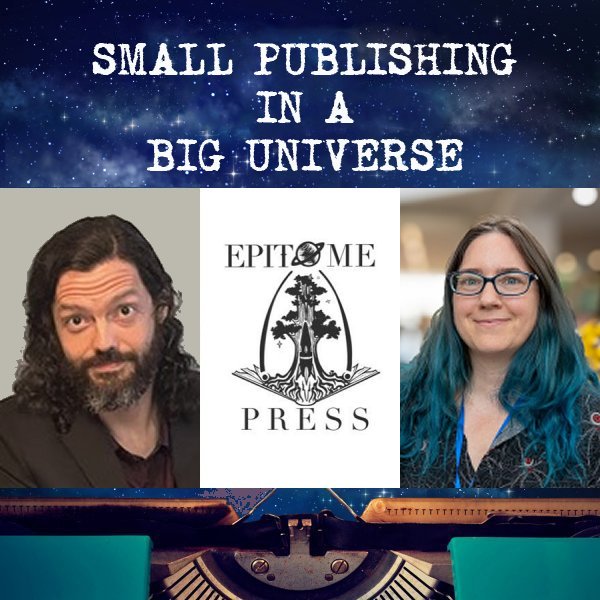
[00:01:19] Speaker B: This is Small Publishing in a Big Universe. Live from Bacon 2026. I am your guest host, Brian Ce Buhl, and I have with me Jason P. Crawford
[00:01:30] Speaker C: and Clfors. You can call me Cherie.
[00:01:33] Speaker B: You are an author artist, package here, is that correct?
[00:01:36] Speaker C: Yes.
[00:01:37] Speaker B: Tell me your origin story.
[00:01:39] Speaker C: Origin story well, Jason and I are a married couple and we are also a publishing team, so we were married first. Neither of us were professional writers, publishers, illustrators, any of that. When we met, we met in the army, so we were both Arabic linguists.
[00:01:55] Speaker B: Sometime later you discovered that you had these talents, or was that part of what drew you together in the first place?
[00:02:01] Speaker D: Well, she's been doing art for a very long time, since she was a kid. But the writing came in when her sister was like, hey, we're all creative, intelligent individuals with lots of fun ideas. Why don't we sit down and write a book? And so we all sat in our living room and we started writing books. And we have not yet stopped that.
[00:02:23] Speaker B: Why don't we talk a little bit about the books that you have out and that where people might be able to find them.
[00:02:28] Speaker D: So I have 14 published novels at this point with now as of today, another 14 written waiting somewhere in the editing pipeline.
[00:02:39] Speaker B: Goodness, that's very prolific. I want to ask what's the source that you're drawing from to write 28 books and ongoing?
[00:02:48] Speaker D: I think that most writers will agree when we say that the ideas just come from random things. Just you'll hear something or somebody will say something, or you'll see a cat running across a field or whatever and you're like, oh, wait a minute, I could make that into a what if this. But really I'm writing the books that I want to read so if an idea sounds like that would be a fun story to read, then it's more likely to sit there and actually grow in my head.
[00:03:14] Speaker B: What do you like to read? Are there comp titles that somebody could look at to determine if they're going to be interested in what you're writing?
[00:03:22] Speaker D: I started out reading things like David Eddings, the Belgariad, the Malorian for fantasy. What I like to read now is really the kind of stuff that I like. Good to win. And so good always ends up winning in my books. Whether or not it's brutal. It's generally brutal getting them there. You know, sacrifice and pain. But they make it out. I don't like grim, dark, I don't like post apocalypse. Those kind of things just aren't as interesting to me.
[00:03:50] Speaker B: So you've got 14 books that are out.
Where should somebody new to your work start?
[00:03:56] Speaker D: I write a lot of different things, so it really depends on if you want this flavor of Impossible or that flavor of Impossible. Since I have such a wide reading taste, I also have a wide writing range. Generally. I would recommend that you go for the first in a series if you're of a mind to. So I have an occult fantasy series, kind of like supernatural, crossed with Pokemon. I have a high fantasy series with a blind princess and a snarky dragon. So those are good places to start. Or if those don't fit your vibe. I've got standalones. We have a werewolf horror mystery. We have an urban fantasy where ideas are made into people. We have a paranormal romance involving the reincarnation of the nymph Daphne. And we have a science fiction where the AI that's supposed to restart human civilization gets knocked off course.
[00:04:45] Speaker B: Some inside knowledge. I understand that you have a prestigious award.
[00:04:49] Speaker D: Yes.
[00:04:49] Speaker B: Would that be a good place for people to start reading your work
[00:04:52] Speaker D: once that's published?
I actually won that on a manuscript. So I won the grand prize osma Award for 2025 for fantasy fiction. That's a division of the Chanticleer International Book Awards. And so that means that my Poseidon based manuscript. By the way, there are no novels with Poseidon as the main character.
[00:05:11] Speaker B: Really
[00:05:12] Speaker D: none that I could find.
[00:05:13] Speaker B: I thought Percy Jackson had a little bit of
[00:05:14] Speaker D: he's in it, but he's not the protagonist.
So my Poseidon novel was the best fantasy novel that that organization read over the course of that year. But it's not out yet. I'm shopping it to agents, hoping to get that as my traditional publishing avenue so I can become hybrid. But if nothing happens by October, we're going to do it ourselves.
[00:05:33] Speaker B: Your team, writer, artist. And then, as you said before we started, you're wearing many hats with regards to how this is working.
[00:05:40] Speaker C: Yes.
[00:05:40] Speaker B: I want to ask about, with the writing, the artist, is it right to assume that the story comes first and then the art follows, or is it the other way around?
[00:05:48] Speaker C: As far as our process goes, you can go either way, but with our process, when I'm doing art for Jason's books, the books will be written first. And honestly, it's best if it's fully written. I read the novels and then I'll either be inspired to do the covers myself or I'll commission another artist if my docket is too full with writing my own or with illustrating my own.
[00:06:10] Speaker B: So you're also a writer. Do you have any stories out that people can find?
[00:06:14] Speaker C: Oh, I do, yes, absolutely. I have a complete 4 book Science fiction series and then I have a standalone science fiction novel. The first deals with Martian colonization. We're 300 years in the future and the world is run by a world government of scientists who thinks they've solved all of Earth's problems, but they've done it in unethical ways. Things like eugenics, outlawing human reproduction without a license. But we've also terraformed Mars and so they want to send the first colonists to Mars. And that's where our collection of characters come in. They all have their own agendas for why they agree to colonize Mars.
[00:06:50] Speaker B: Jason gave his answer for where he gets his ideas. Do you have a different answer for where your ideas and inspiration come from?
[00:06:57] Speaker C: A lot of times they come from life experience. I would say that I am very frequently and always being inspired by story ideas. Not all of them get written. For my series in particular, there's definitely a lot of future politics involved. And it was inspired by the fact that we've been phasing out midwifery. The midwife, when I was pregnant with my third child, was arrested for practicing as a midwife. So that kind of was a story seed. I thought, well, what if you could outlive that and try and reinstitute things that you believed in.
[00:07:29] Speaker B: So you've done art covers for Jason's books. Do you do covers for anybody else?
[00:07:36] Speaker C: I do, yes. I do my own covers for my books. Last year I did the COVID for the superstars anthology Requiem, Tales of the Undead. And you can get that
[email protected] and then some others that I've done. I did one this year that Isn't out yet. And so I guess I won't announce that one. And I did the COVID of a public domain work by Frances Stevens, the heads of carebruce. So I put that out through Wordfire Press as a part of my thesis project. She was the first female sci fi and fantasy author in America. And so her work is public domain, or at least this one was. And I did the COVID and illustrations on that one. Also the COVID of another anthology, Chaotic Cupids. So there's a good number and more coming out.
[00:08:20] Speaker B: It sounds like you're staying very, very busy.
[00:08:22] Speaker C: Yes.
[00:08:23] Speaker D: Yeah.
[00:08:23] Speaker B: Jason, how about you? Are you staying constantly busy in the same way or.
[00:08:27] Speaker D: I don't have as many things to do.
[00:08:28] Speaker B: But you have written 28 stories.
[00:08:30] Speaker D: I have. Plus short stories that I try to get to various markets and whatnot. But really the busyness comes in with the competing interests. Right. Writing is not yet enough to be a sole source of income. So I have to work my high school teaching job and my college teaching job. Finding the moments where I can squeeze in word count is sort my fight with busyness. Because I have to do my job and they're kids. I want to do it well, but I also need to write.
[00:09:01] Speaker C: And we also have four kids. And we have
[00:09:02] Speaker D: four kids.
[00:09:03] Speaker B: Both of you have a lot pressing on your time. Do you have any tips or tricks that you would offer to people? What is it that you are doing to really help you stay focused and put words on the page?
[00:09:15] Speaker D: Well, I'm fortunate that I have had the opportunity to test my limits. So if you imagine kind of weightlifters, you have something called the one rep maximum, which is sort of the limit of your strength. How much can you do once? And so on my way to the International Space Development Conference last year, I got stuck in layovers and flights. You know, cross country, six hours of flying, four hours in the airport. So, you know, I was in. I had nothing else to do all day but write. And so I ended up writing something like 10 and a half, 11,000 words that day. And obviously I'm not going to do that every day. That's ridiculous. But it showed me that I could do a lot more than I was. It showed me what my 1 rep max was so then I could start pushing my daily finding the places to shave other things where I was wasting time.
[00:10:05] Speaker B: Is your philosophy you must write every day or where do you call
[00:10:08] Speaker D: that? I have to, unless I have given myself permission not to.
[00:10:13] Speaker B: Are there any other tips or tricks from a marketing strategy perspective that new Authors might not otherwise think about that you've discovered in your experience with cons or in just in general. However you want to answer that really
[00:10:25] Speaker C: well. Starting with cons. The first thing is mindset. Going into a con, as a new author, you should not expect sales to be phenomenal and the lines to back up around you. And you don't want to get disappointed or stressed out about that.
[00:10:39] Speaker D: People aren't coming to see you. That's not going to happen.
[00:10:42] Speaker C: So you bring your best and you bring a positive mindset as long as you're talking to people. And maybe you sell a book, maybe you don't. Usually you'll sell some as long as you engage people. You got to consider your first cons. That that's a success. You showed up and you're learning. Go around to other people's booths, take pictures, ask them questions, and learn what kind of setups they're getting, where to get the cheap things for setting up, and then also the things to aspire to. Like, people will look at our massive banners we have at my cool sticker display, and you can tell. Some people are like, oh, I couldn't do that. Or I wish I had that. We didn't have any of those at the first cons. We had a table and we had our first few books. So you have to expect to build up to it. And you gotta be standing as much as you're able. You've gotta be standing. Being
[00:11:27] Speaker D: able to stand, you need to stand, right?
[00:11:29] Speaker C: Getting people's attention in a friendly way. And for God's sake, pitch your books.
If people are willing to listen to a pitch, you can be like, hey, do you want to hear about my book? Pitch your book. Because your signs aren't enough. Your covers are not enough, even when they're pretty. For most books, you have to pitch your book. So take the time and you just do it. And if you're scared, it's okay. It gets easier.
[00:11:49] Speaker B: Do you have any advice around pitching itself?
[00:11:52] Speaker C: Oh, absolutely. Tell a story. You want to be succinct, but you want to design the pitch. Learn it in advance. It's okay if it changes a little bit as you go and every time, but you know what you're going to say. And it should be telling your story in a phenomenal way. Something that will get people excited. And then while you're pitching to them, you'll see when their eyes light up, or you'll see when they gloss over. And then you can know, oh, let's pick it up a little bit. Or throw in this exciting bit that I sometimes use. So you learn as you go.
[00:12:21] Speaker B: Is there any other media that you look at as other marketing opportunities or other ways to get the word out about your stories?
[00:12:29] Speaker D: Most of that comes in opportunistically.
We don't have a consistent marketing professional, social media presence or manager or anything like that who's making sure, hey, today you gotta post this or, you know, put these pictures up. That doesn't happen. What we have are a wonderful community of writing professionals that we talk to and about.
Someone will be like, hey, I'm doing this podcast. Does anyone want to be on it?
Or you happen to know somebody who reviewed your book previously on a YouTube channel and so you reach out, hey, I. So it's very opportunistic at this point because the focus is on getting the books written and then bringing them to people.
That's where we're at.
[00:13:18] Speaker C: Yeah, we do have both have social media presence.
[00:13:21] Speaker B: We exist,
[00:13:22] Speaker C: you know, and we're decently active on a number of different ones. The advice that I would give and that I've been given is have a presence on at least one social media that you feel comfortable enough on where you'll semi regularly post some stuff where people expect to see you and then have outposts on all the others where you've got an account and sometimes you put stuff there or you auto put stuff there so people can find you and get to the place you are and your own website, things like that. Newsletters.
[00:13:55] Speaker B: How important are newsletters to you?
[00:13:57] Speaker C: So, so I have a newsletter. I'm going to be more regular with it in the future. I'm working on a double master's degree right now, so I've kind of let the newsletter slide a little bit. But the newsletter is there to keep working with. Jason just put a. An update out on his last night. So he has a newsletter as well, but it's not a massive part for us yet, but it's something that we're going to keep building into. I think
[00:14:20] Speaker D: the point of a newsletter is that you have people who have said, yes, I want to hear from you.
The issue is that most people are signing the form or downloading the story or whatever because it's socially expected and don't actually engage with the content.
And so again, that's why most of my effort goes into people as opposed to being present for the storytelling,
[00:14:47] Speaker C: because people are fatigued with how much comes into their inbox and how much they're being advertised to. And so it can be difficult to Decide what's worth the effort. When you have minimal time.
[00:14:58] Speaker B: Is there anything that you've learned along the way that you didn't know going into it? Things that are in obvious that maybe somebody new to the process should. Like, if you had known this, it would have been super helpful.
[00:15:11] Speaker C: There's little nuanced things, and then there's the larger overarching things. One of the things that I would say is, one of the larger things is to put some research into exactly what something like editing means. Everybody, you get these anecdotes like, well, everybody's work needs edited. And. And an author might be like, yeah, but does mine? What do you mean edited? Can my friend do it? And I'm certainly not gonna say you have to go hire professional editors. But if you're not gonna do that, you have to go learn about editing. You had better not just think, well, I'm such a good writer, I don't need an editor. You should think, oh, let me go research the different levels of editing, the different types of editing, and if I think I'm gonna do it myself, then learn what goes into each of those and teach yourself or find a teacher. But you need to take it seriously, not just shunt aside something that hubris might tell you. You're already above. So taking that kind of thing seriously early on is a good idea, because I keep hearing authors say, well, this was my early work and I. I wouldn't write it that way now. Or I'm thinking about unpublishing that one. We all grow. So I definitely can relate to. Well, I know my most recent release is better than my first book. Of course it should be right, or, what am I doing? I'm stagnating. But to feel like the first one was so rough that you should unpublish it, that's rough. So if you're just about to publish or thinking about publishing, don't let fear keep you from putting the work out, but take those things seriously. You know, the making sure you know how to polish it.
[00:16:42] Speaker D: And as a corollary to that, don't rush.
So one of the things about publishing work yourself is that you have control of the timeline. And you might very well be like, this is so awesome. I'm so proud of it. I've had it looked at. I'm ready to go. I'm chomping at the bit. Do a little bit of lead up. Give yourself three months, six months, something to get people invested and interested, Talk about it. Drop snippets, something.
Because otherwise you're going to release it, and your mom might download it and your best friend probably won't, and you're looking at nothing. And then you're either disheartened by that, or it just looks bad that you've had a book published for nine months and there are two reviews on it. That's not ideal. So give yourself a little time. Not tons of time. You don't want it to sit there for three years in the shelf while you're not doing anything with it. But build that into your strategy. That's the thing I would tell myself,
[00:17:40] Speaker C: and the best that you can do at marketing, as long as you're going to put some effort in, find out what some people do, and you're like, well, I've got this much money to put into this, or even if you don't have money,
[00:17:51] Speaker D: you
[00:17:51] Speaker C: know, or this much time, the best you can do is better than doing none.
[00:17:55] Speaker D: Yeah. Don't pay scammers. No,
[00:17:56] Speaker C: no, no, don't do that. Please don't do that. Another thing I would add is your cover, right? Your cover matters. We've already said that. I'm an artist. I'm a cover artist. I'm not saying hire me as an artist unless you want to. But your cover matters so much. It sells the books. When Jason had written his first book and he was in a rush, I
[00:18:16] Speaker D: was.
[00:18:16] Speaker C: He really wanted to just put it out. And I was like, slow down. What are you doing? We need to figure out what we're doing. And he put together a cover that was. It was just, you know, like clip art,
[00:18:25] Speaker D: stock images,
[00:18:26] Speaker C: stock images kind of thing. And I was like, and I'm an artist. And I wasn't. I hadn't ever done any book covers yet. And I wasn't as confident as I am now. But still, I looked at that. I'm like, no, she didn't stop me is the point.
[00:18:38] Speaker D: She didn't stop me.
[00:18:39] Speaker C: I didn't stop him, but I did try. Say, could you just slow down a little bit? Let me figure this out.
[00:18:43] Speaker B: Did you ever re. Release it with a better cover?
[00:18:45] Speaker C: Oh, absolutely.
[00:18:46] Speaker D: 100%.
[00:18:47] Speaker B: Did you see, like, a launch? Like a. I
[00:18:49] Speaker D: mean, it's definitely better. It did not live very long with the old cover. We saw that very quickly. I want to
[00:18:55] Speaker C: turn
[00:18:56] Speaker D: back. We were like, nah, nah, I shouldn't have done that.
[00:18:58] Speaker C: Well, and I told him, I was like, okay, look, if you need this out now and you need covers, I will make your covers. It's okay that I've never done it before your cover matters so much.
And you need to find a real artist, preferably. And a lot of us, we don't make that much money. Jason and I are living on teacher salary with four kids, so that's not a lot of money. But I do want to say that when I don't make the covers, we pay artists and we pay them what they're worth. We just budget it. Most people can do that. If you can't do that, you probably have a friend who isn't ready to charge big rates yet. And it's gonna be better than stock art or stolen art or things like that.
[00:19:40] Speaker D: And this is a good place to point out that there's a lot of public domain original, awesome Renaissance era artwork that could be incorporated into a cover. You could take any of Leonardo da Vinci's original paintings, high res photos of those, put them into a cover somewhere, and nobody can tell you not to do it. And it looks super cool if you do it right and it's free like that part of it is free. If you're sitting here going, well, I don't have a few hundred dollars to spend on a cover. I get that. I get that.
Go there, go into the artists of antiquity, find a Sumerian cave painting that some archaeologists took a picture of in the 1800s and then put that on there.
[00:20:23] Speaker B: I'd like to close with one of my favorite questions and I want you both to answer. Since you're both writers, what is your favorite writing advice that you would give to somebody that's just starting?
[00:20:33] Speaker C: My favorite go to writing advice is something that helps you avoid what we all want to call the dreaded writer's block. I believe that most of that stems from negative self talk. Whether you are hearing these thoughts clearly or you just sit down to write and you suddenly feel dejected or overwhelmed or like the words aren't going to come. And if you're busy hating yourself and you're busy being your own worst boss, the kind that's going to, you know, abuse you when you walk in the door, who wants to work for that? That cuts and kills all of your creativity. So negative self talk should not be allowed in the writer's brain. You can write at your best, even if you think it's bad, and be kind to yourself and then you can move on from there.
[00:21:17] Speaker B: I like that.
[00:21:18] Speaker D: Yeah, that's, that's excellent. Mine is a little more self centered than that.
It is that if you enjoy the book that you've written or the book that you are writing, then there are enough people on planet Earth who will also enjoy that same book that it is worth writing. You are not so unique in your reading tastes that you are the only unicorn who will ever care about this story. Other people want it if you want it and so it's just a matter of finding those people. So finish the book.
[00:21:54] Speaker B: Thank you again for your time. This has been absolutely great.
[00:21:57] Speaker A: Thanks to our event host Brian C.E. buhl and our guests Clfors and Jason Crawford, we plan on publishing a new episode every month. If you want to know more about small Publishing in a Big Universe, visit our
[email protected] and subscribe to our newsletter. Send us your feedback by using the Contact Us link and like us on Facebook PBUpodcast. To find out more about the books and other products featured during this episode, please visit the Small Publishing in a Big Universe
[email protected] this podcast was recorded and edited by Lisa Jacob. Executive Producer is Steven Radecki. Theme and ad music is provided by Melody Loops. If you'd like to donate to help us with web hosting equipment and other costs, please add to our tip
[email protected] youm can listen to our podcast on Apple Podcasts, Spotify, Amazon Music and most of your favorite podcast services. Thank you very much for listening and see you next month.