[00:00:00] Speaker A: Foreign.
[00:00:07] Speaker B: Hello and welcome to Small Publishing in a Big Universe. I am your host, Lisa Jacob. Coming from our sponsors this month from Water Dragon Publishing, Bermondsey Girl by BJ Sykes from Paper Angel Press. To have and to Share by Greg Stone.
To have and to Share by Greg Stone Book 3 of the Ronan Mazzini series. It began with temptation and ended in bloodshed. The police asked private detective Ronan Mazzini to investigate murders in the polyamory community where experimen spills over into violence. Mazzini is afflicted and in many ways gifted with synesthesia, a condition that makes his senses cross over in complex patterns. His distorted visions are a low level superpower, providing astonishing insights as he tries to find the killer. To haven't to Share is available this month from Amazon, Barnes and Noble, Kobo, Apple Books, Google Play, Smashwords and other online booksellers. Or support your local independent bookstore by ordering it through booksh.
For more information, visit paperangelpress.com.
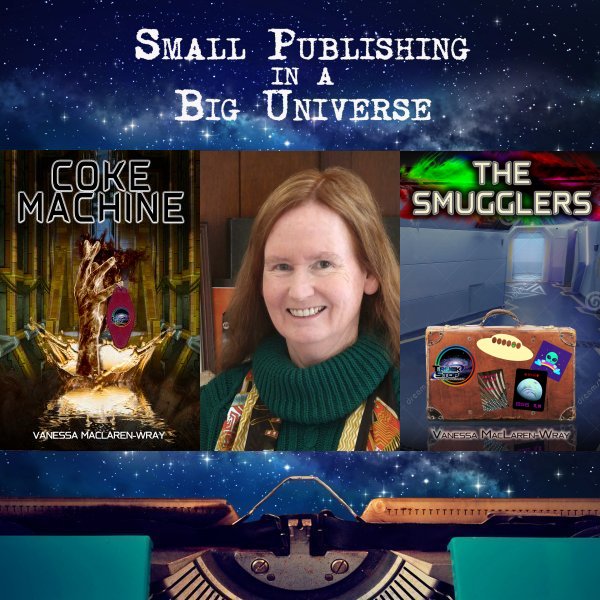
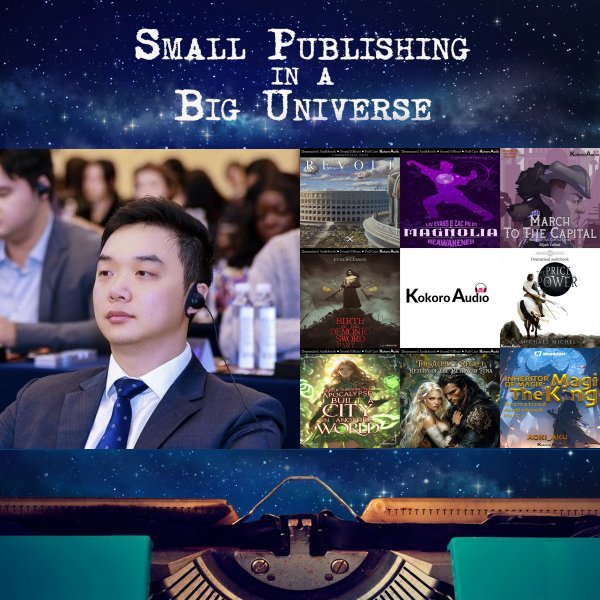
[00:01:45] Speaker C: It's Vanessa McLaren Ray at Worldcon Seattle. We're live with Alex Moore of Kokoro Audio. And so this is going to be a different taste of a new kind of person that you want to talk to. It's not all about the print books. Sometimes it's about audiobooks. Alex, tell us a little bit about yourself and why you decided to start an audio company.
[00:02:12] Speaker A: Yeah, absolutely. Tokoro Audio, we are an audiobook producer and a distributor primarily only do dramatized fully cast sound effects, soundtrack, the whole real cinematic experience. The tagline we're trying to stick with the company is a cinematic experience true to author's intent. The reason why I started the company is because before coming here I thought I read a lot, but then really shown who can read and who can't. I'd like to think it's because the fact that I can speak three languages, English, Chinese, Mandarin and Japanese. Due to that, my selection of titles does kind of increase.
[00:02:49] Speaker C: It's more than triple.
[00:02:50] Speaker A: Yes, yes. It slightly goes up. I mean those two markets are also extremely big in regards fantasy, sci fi and whatnot as well. Because of that, whenever I do finish the few popular titles in the Western sphere, I move on to the Asian sphere and then go through those titles. So as a result, I haven't really gotten down into the nitty gritty like indie scene. But when I was reading the books in the Asian sphere, I predominantly read web novels or what's known as light novels over there and I noticed that no one was doing dramatized audiobooks for those titles. Even though they were very popular, a lot of them do get adapted into an anime.
So there's definitely a following.
And I couldn't for the life of me understand why this wasn't happening. And so when I got sick with my corporate job, I had a few months where I was just kind of racking my brain thinking about what to do. And then I thought, hey, I thought of this before. About indie published online web novels not having audiobook or dramatized audiobook adaptation. There's definitely a market for it. People enjoy reading it, they enjoy watching the adaptations. And sometimes just due to like budget constraints, there's no second season, no third season, but there's fans clamoring for the continuation of that story. I have all these things that seem to be pointing stars are aligning to have a audiobook production company that specifically looks at target that sphere. And after starting it, I've also been exposed to the indie scene that I was talking about. And just the community for the indie scene is also something that's really opened my eyes for the love of fiction that people have the ability to use your time much more efficiently because of
[00:04:32] Speaker C: audiobooks, but you're doing full production. So what does that mean, a full cinematic experience? Experience.
[00:04:38] Speaker A: The full cinematic experience is where we have voice actors play pivotal roles. So usually your main characters, your semi main characters, for example, like Gandalf, he is a prominent character throughout the story. So we give characters like those a unique voice. We look to identify the side characters who appear throughout the story and assign voice actors that have a very wide range and are able to express a lot of different accents, a lot of different characters. Some of these voice actors are so skilled, it's amazing what they can do with their vocal cords. We look to identify that, ensure everyone is cast correctly. And then once we've gone through the assigning of characters, we then direct. Depending on what the voice actor's preferences is, we look to direct their lines. Because with some books that are like 10,000 pages long, the voice actors don't have time to read everything. So as the production team, we need to ensure that we understand understand the themes of the story, what the author wants in regards to like how a character sounds, any things that they think the character has is like a habit or like a speaking kind of tick. We can look at all incorporate that in regards to the line direction. So that's where our director will direct them through recording sessions. After that, once we have all the lines and we put it all together on the timeline, we then provide those files to our sound designers who go through and apply sound effects based on the script that we've adapted. And then finally we also add a soundtrack for an atmospheric, adding that extra oomph to a very crazy action scene or a sad, very vulnerable character moment. We add soundtracks that kind of fit the mold or the vibe that the author wants for that scene and eventually put all that together and then push it out onto platforms.
[00:06:24] Speaker C: Wow, you're basically putting on an audio play.
[00:06:27] Speaker A: Yes, yes. It basically is that there's, there's a few words audio play, radio play, like back in the day audio drama. They typically do fall under structure wise. There isn't a narration for those. So when we do like the dramatized audiobooks, we have a narrator usually either in the first or third person. And there's that slight difference. To be honest. It's a very like the lines are a bit muddled on where it falls in regards to like a radio play, audio drama audiobook, but we're pretty much all encompassing in that area.
[00:07:00] Speaker C: Yeah, it's a cool approach. So how do you find your performers? For example, if somebody's a young voice actor who's listening to this says oh my gosh, I want to work for them. Do you have a group of people that you call on regularly or do you have open auditions? What do you do?
[00:07:14] Speaker A: Yeah, so currently we are looking to. Because we did start in 2022 so it's only been a while and we are looking to identify talent for voice acting purposes. We do have a small roster already of voice actors that we've worked for for previous products. However, at the moment we still look to put out a casting call either on X Blue Sky. I've recently found out they're on Instagram as well and there's some very media specific related sites such as Voices 123 Voices casting Core Club Backstage. There's a whole plethora of platforms as well on top of that. So you can find us on any of those platforms. I think the most easiest, no barriers to entry one would be Casting Core Club. It's like a small kind of indie voice acting, script writing, fan made fan production site. Because some places do require for you to pay for profile, for you to pay to audition and whatnot. So an easier barrier to entry would be through Casting Call Club or Twitter or Egg. And we also do have a website as well with an email address. So if you want to send auditions through that way, that's also available with the email address we have provided. Feel free to send us Your reels, if you're interested at all. But also you can keep an eye out for auditions through that way and then apply through the relevant channels.
[00:08:37] Speaker C: So do you have books out?
[00:08:40] Speaker A: Yes.
[00:08:40] Speaker C: So tell us about a couple. Maybe the most recent production or maybe your first one.
[00:08:44] Speaker A: So I did mention that we do web novels specifically was what kind of got me into the idea. Currently we are working with webnovel.com which is the web novel RPG publishing arm for Tencent. They put out a lot of stories. Some of those writers in the web novel sphere are, for a lack of a better word, a little bit insane. With the amount of words they put out, it's actually mind boggling how much they write in such a short amount of time. A good example is we are currently doing the production for part two of Birth of the Demonic Sword, which is a transmigration Chinese cultivation wuxia story.
And that title has about 2 million words.
And when we did our pre projection for how the project will take to finish the whole 2 million words, it's looking about 5 plus years worth of continuous production, which is.
[00:09:38] Speaker C: Goodness.
[00:09:39] Speaker A: That is the reaction everyone has had and I have had when that figure was popped out. But it's a little bit daunting to think about doing a project for that long. But I love the story, it's great. The fans that been exposed to it, they all love it as well. They're. The production was great, they're very keen for part two. Part two is currently in post production. It should be done quite soon, so they'll be able to see that as well.
[00:10:01] Speaker C: What would the timeline be like for say a 125,000 word fantasy novel by comparison?
[00:10:09] Speaker A: So 100, if we're going around 125,000 words, that is a around 13 hour audiobook. I believe when it's a first book there is a little bit more pre production time required because we go through auditions and find a suitable voice. Depending on how much the author wants to be involved in the process as well. We can also look to provide them a short list because we wouldn't want them to go through the entire audition list. It goes up to the thousands. So that's definitely not viable for authors, I think. But yeah, providing them with a short list of authors that we think kind of suit the character. I mean we take notes, an age, voice type. Any reference characters that are in media that we think they use a reference point. When we go through the auditions, this
[00:10:54] Speaker C: one's like Rambo and this one's like Gandalf.
[00:10:56] Speaker A: Yeah, yeah. But then because of that, initially getting a completely new IP for audiobook purposes up and running takes somewhere around 425,000 words, about seven to eight months. Once again, it also depends on how busy the author is and how involved, once again, they want to be with it. Because other things that we look to do is obviously we discuss with the author the Vibe story, like themes you're tackling, pronunciation lists. I mean, even without the fantasy names, just like normal names. Like a recent issue we ran into was there was a character with the name spelled I Vor. So being from Australia, maybe this is from Australia, but I thought it was Ivor. But then we had another voice actor, I think it was evil. Didn't. That was something that we, we missed in the pronunciation guide that we gave for all the characters. So we had to, we had to retake like those certain lines, which wasn't too, too bad. It was quite easy to do because it was minimal with the name spoken out. But it was still something that we were like, oh, we need to pick up on this next time and ensure that it's done. Like not even just for fantasy names, for just, just normal names in our world right now.
[00:12:04] Speaker C: I'm not going to ask you what this costs because it's got to be fairly substantial. So if you're comfortable talking about what this kind of production costs, I will say okay. But it seems to me that it's a, it's a major operation. It's going to involve a lot of people over a substantial amount of time.
[00:12:21] Speaker A: Obviously it does cost a little bit more than doing a standardized, unabridged 1 narration, 2 narration audiobook. Especially with the sound effects, mainly the sound effects and the soundtrack. The cost can quite go up depending on a few other factors such as how many extras we will require. Especially for stories that sometimes it's like all male side characters or like all female side characters. And then we have a scene where 14 different characters appear and we, we want to make everyone sound a little bit unique. We don't want a voice actor speaking to themselves as two different people.
Like it's doable, it's definitely doable. But I think it does kind of break the immersion of the dramatize the production cost wise. It does get a little bit more inflated to the extra production that we put in. However, I've been talking to a lot of the indie authors here recently.
They, they've got some great ideas like some of them have been talking about just doing multicast and soundtrack. They're happy with not having the actual sound effects in. And that will cut down on cost a lot. And it wasn't something that I thought of as a service or like a product to be able to provide to everyone. So I'm still looking to finalize numbers and get back to the one aspect
[00:13:35] Speaker C: of that that I'm hearing is you're coming to a convention, you're meeting lots of people, and you're learning ways that you can flex your business model to meet a huge demand.
Everybody wants to have an audiobook in ways that will make the authors happy and get the readers attached to the books. So that's. And that's the kind of thing you can only get when you are actively interacting with people, whether it's in a virtual format convention or a live one like this, where you're in person and can talk to people.
[00:14:02] Speaker A: Yeah, exactly. One small thing that has kind of also been that I've kind of thought of after talking to all the indie authors here and talking about the financial restraints in regards to getting an audiobook done. And then the slight worry with a fully dramatized one is something we can look to do promotional or kind of collaborate with the authors is having them pick a scene that is very pivotal to their story. So that makes a shorter overall sample. This may be 5, 10 minutes of very epic action scene or a scene where the character has to go through a very big development in their character and then making a short dramatized clip of that. And then because all the indie authors, they do their own marketing through social media one or even through sales, it can be something that comes attached with the book. And then if there is enough traction with the sample itself, they might be more reassured to go through with the actual production of a fully dramatized one. And then hopefully alleviate any worries about if they do decide to either we go through an audio rights acquisition or if they want to hire us to produce it as a service, they at least feel have a better ability to estimate whether the client base that they have wants to actually listen to this
[00:15:19] Speaker C: dramatized audio because they know their audience and if the choices are clear on the different ways they can do things, then they can make reasonable choices for their own work. And that's great to hear. So where can people find you in the future?
[00:15:33] Speaker A: We have our website, www.kokoroaudio.com, in case for anyone that doesn't know how to spell it, it's K O, K O, R, O and then audio in English. We also have an Instagram, we have an X and we also have a YouTube channel and on the YouTube channel we have samples of all the audiobooks that we've produced. They are all one hour long. Because I do not like five minute samples, I find them pointless and they don't help the customer or inform them about the product that they buy.
[00:16:03] Speaker C: Thank you so much for spending so much time to talk to me about this new operation and your wonderful business and your ability to listen to what authors are hoping to see from their story.
[00:16:14] Speaker A: The whole thing about being a business is being solution orientated and I think there's personally something that I love which is reading there has to be a way to make this work for people and I'm looking to explore that.
[00:16:26] Speaker B: Thanks again to our guest Alex Moore and our guest interviewer Vanessa McLaurin. Ray we plan on publishing a new episode every month. If you want to know more about small Publishing in a Big universe, visit our
[email protected] and subscribe to our newsletter. Send us your feedback by using the Contact Us link and like us on Facebook @SPBUpodcast. To find out more about the books and other products featuring during this episode, please visit the Small Publishing in a Big Universe Marketplace at sp.
This podcast was recorded and edited by Lisa Jacob. Executive Producer is Stephen Radecki. Theme and ad music is provided by Melody Loops. This month's episode was sponsored by Paid for Angel Press and Water Dragon Publishing. You can listen to our podcast on Apple Podcasts, Spotify, Amazon Music, and most of your favorite podcast services.
You can meet us at bacon 2026 or westercon78 during July 3rd through July 6th.
Thank you very much for listening and talk to you soon.