[00:00:00] Speaker A: Foreign.
[00:00:08] Speaker B: Hello and welcome to Small Publishing in a Big Universe. I am your host, Lisa Jacob. This month from Water Dragon Publishing, the Eliminator by Alan Dyer Shapiro From Cupid's Arrow Publishing. Diamonds aren't a girl's best friend. Love Is by Felicia Carparelli, Cupid's Wanderlust by Kostatin Georgieff the Sentience by Maurice Temple and from Paper Angel, Founding Daughter by Wallace Bain. Stay tuned for live from Worldcon 2025, part one of a three part epis.
Founding Daughter by Wallace Bain. What if the noble words of the Declaration of Independence were not written by Thomas Jefferson but by an author of a much lower station still aspiring to be free? What if life, liberty and the pursuit of happiness was an idea of an especially precocious, bookish, half black, teenaged servant girl with a boundless faith in the ideas of the Enlightenment?
Founding Daughter is available this month from Amazon, Barnes and Noble, Kobo, Apple Books, Google Play, Smashwords and other online booksellers. Or support your local independent bookstores by ordering it through bookshop.org for more information, visit their website at paperangelpress.com.
[00:02:00] Speaker A: Foreign.
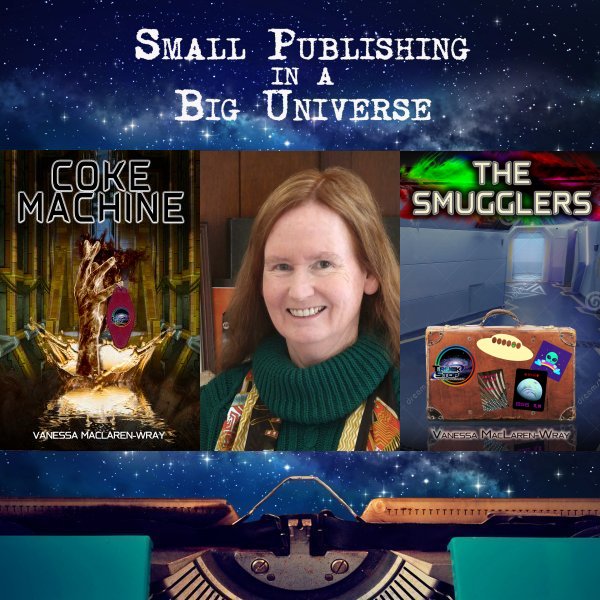
Hi, this is Vanessa McLaren Ray with small Publishing in a Big Universe live at worldcon Seattle. And this is so exciting. We have a debut author with us here today, Emily Wagner, going to come and talk to us about life, the universe and Go Back. So tell us a little bit about Go Back.
[00:02:26] Speaker C: It's a near future dystopia and it's about a journalist who uncovers the government's plan to take everyone's tech and lock them up in a tech detox center because the government is kind of in cahoots with the Go Back movement. So the journalist, Sarah Grimes is my main character. She's locked away in this tech detox center and has to escape. Her world is turned upside down as well as everyone else's.
[00:02:51] Speaker A: So it's kind of a thriller?
[00:02:52] Speaker C: I think so, because it's very fast paced. Yeah. Twists and turns everywhere she goes.
[00:02:57] Speaker A: So she never knows what's going to happen next.
[00:02:59] Speaker C: Exactly. But Sarah is definitely the main protagonist as well as Olivia. It's a dual pov.
[00:03:06] Speaker A: So we get to see this universe from two different perspectives. Two different women coming at it from different directions.
[00:03:12] Speaker C: Yeah, Olivia, she works with Go Back. So she's an insider who tipped off Sarah and that's how she was able to write the article. And these two women worked together to take down the government.
[00:03:26] Speaker A: Bad kind of story. Oddly quite timely. How long have you been working on this book?
[00:03:30] Speaker C: Started writing it in 2017, and I wrote most of it in 2017 and then it just took years of revising and finishing it and then revising and kind of. I queried it for a while with agents and then just set it aside and wrote other stuff and landed it through my small publisher.
[00:03:51] Speaker A: What inspired you to take on this kind of story? Had you worked in journalism, were you anxious about technology?
[00:04:00] Speaker C: I am a former journalist, just like my main character.
So as a former journalist, I'm always questioning. I'm also horrible at directions and I rely heavily on gps. So just one day I just thought, what would happen if I had no gps?
And also I've learned that a lot of kids aren't learning how to read maps nowadays. Well, what if they had no GPS and they had to read like an old school map and it just kind of went from there?
[00:04:25] Speaker A: Excellent. Anyone wants to follow Emily, go to her website and what's the name of your website?
[00:04:31] Speaker C: Pretty easy. Www.emilywagnerwrites.com if you sign up for my website, you get a free story.
[00:04:40] Speaker D: Free story or my newsletter.
[00:04:41] Speaker A: Yes, yes, do that. Get a taste and then get the book.
[00:04:45] Speaker C: Yes, get the book and show up
[00:04:47] Speaker A: for the cons on the east coast and you can meet her. She is wonderful to talk to. And we're out of time.
Thank you for making time. I know you were in a rush today and I really appreciate you stopping by.
[00:04:59] Speaker C: Okay, thank you, Vanessa.
[00:05:03] Speaker E: This is live from Worldcon 2025 and my name is Brian C.E. bueller and I have with me Moses Solomon. So you're an independent published author?
[00:05:13] Speaker F: Yes.
[00:05:14] Speaker E: I know that there is a lot of thought that goes into making that decision. What was the deciding factors for you to go indie publishing?
[00:05:23] Speaker F: Part of it is that I didn't really go fully into writing until I took early retirement. So I'm not a young person with a lot of time and I really wanted to spend the majority of my time actually writing the work.
And if you are going traditional, you need to spend a good amount of time submitting to agents. And then if you're able to land an agent, then you work with the editors and the whole sales and marketing team. It takes up a good portion of the time.
And I'm writing a series, so I really wanted to see the series all the way through to its end while I'm still vibrant and healthy and of good enough mind to be able to handle the subject matter that I'm writing. There's one other factor for this particular series of books, which is that because it's a personal passion of mine.
And I thought long and hard about would I be willing to let some of the more quirky aspects of the story go. Would I be happy with it? And I decided I really wanted the story that has been with me to be in the final form as I wanted it.
[00:06:42] Speaker E: I think there's nothing wrong with wanting to have that full creative control. That's a valid part of the decision making.
[00:06:49] Speaker F: Right. But you do compromise, though, on how saleable the book might be if you put too many unique things in there,
[00:06:58] Speaker E: how accessible it's going to be.
[00:06:59] Speaker F: Right.
[00:07:00] Speaker E: And then there's some readers are looking for very specific things, but then there's some readers that are actually looking for things that are outside the box, like outside the box thinking, and they're looking for things that are newer.
[00:07:10] Speaker F: Right.
[00:07:11] Speaker E: So, yeah, you know, you've got all that to weigh in your considerations.
[00:07:14] Speaker F: Right? Yeah. But the time factor was pretty much the deciding factor.
[00:07:20] Speaker E: We've talked about the publishing of it, but what is the story about?
When somebody comes up to your table, what's your pitch that you give to them?
[00:07:28] Speaker F: My pitch is the story is called the Ruler of the Galaxy. It's the first story of the series.
And in the Ruler of the Galaxy, I write space opera in the very classic tradition. It's very large, very big scale. I try for an epic feel with lots of characters.
And it takes place in a region of space known as the Central Empire of Urania. And the empire itself is made up of many core factions that contend with each other politically for control of the Imperial Crown.
The main characters are a young couple in the military, Morgan and Reina, who are assigned to different ships.
And as long as their ships are on different missions and they're separate, everything is good with Morgan's captain, because he is Reina's father and he's a little bit overprotective of her. So the story actually begins when the two ships come together for maintenance at the same space fortress, and the two of them check out a small craft to go on leave, and they pass by what should be fairly primitive, innocuous planet, and a beam of energy shoots them down to a crash landing on the planet. And when they're on their planet, then they encounter people who have strange beliefs that some people consider mythical, but they are exhibiting powers and a technology that shouldn't exist on that planet.
And from there they get involved in some of the darker aspects of the religious beliefs of the people throughout the Empire.
And some forces started being razed to form An Invasion of the Empire.
[00:09:33] Speaker E: So the first book is out.
[00:09:34] Speaker F: It's actually two books.
[00:09:36] Speaker E: You have two books out now?
[00:09:37] Speaker F: I didn't want to write a super huge War and Peace volume, so I split it up into two books.
[00:09:43] Speaker E: And there's more in the series?
[00:09:45] Speaker F: Yes.
[00:09:46] Speaker E: Do you have an idea for how many more books there's going to be in the series?
[00:09:49] Speaker F: As of now, I am intending to have a total of seven volumes, of which the Rule of the Galaxy is the first two. And it will span the length of the war that breaks out to its conclusion.
I am expecting three single novels and then another duology to conclude it.
[00:10:13] Speaker E: Have you started the work on the next books?
[00:10:16] Speaker F: I have started work on the next book and I have about halfway through the first draft of the next book, as well as an accompanying novella because there was one of the characters that I felt I needed to explore a little bit to see whether this character is going to stick or not. So I wrote a novella centered around this supporting character and I'm working on that as well.
[00:10:44] Speaker E: What's your process to get it from beginning to end and then published?
[00:10:48] Speaker F: It's a different process for the next book than it was for the first two, because the first two I started in 2013 and then I took a pause for about seven years or so, picked it back up during the pandemic and finished it off Then at that time I was still very much learning being a student on the whole, how to be a good writer, and I still am, but so I relied very heavily on an editor who was almost like a mentor teaching me, you know, this is what you need to do to write.
Now, I do belong to a critique group and I've run chapters, some of the chapters I've run through more than once. And so I take all the feedback and think about what I want to incorporate for that. Once I have it in the form that I really want it to be in, then I send it to editor that I used on the first books. And I have a.
A local artist in Portland who does all my cover work and so I'll have him involved as well. So then once that's all done, then I upload it, the layout and all that. I do it myself.
I want a certain look.
[00:12:07] Speaker E: As you have learned through working on this series. If you were to meet an up and coming writer that wants to learn to do what you're doing, what would be your favorite advice that you would give them?
[00:12:18] Speaker F: My favorite advice that I give myself still is to enjoy being a student and be a sponge to learn from people who have gone ahead of me because my previous career is completely different. And there's a certain youthfulness, I think, to feel like you're starting something that is so different and so new that there's a lot to learn. I had a lot to learn. I still do, about the writing craft itself. I'm still learning about the business of writing. The business of the industry itself is always changing, even more so now than 10 years ago. But I enjoy learning. I enjoy learning from others. And so whatever critiques that people give me, I always keep in mind that it's with the intention of helping me do better. And I take it in that spirit. And that would be my number one advice for anybody who is trying to do what I do. Keep learning and keep enjoying the learning and discovery process.
[00:13:23] Speaker E: This has been Moses Solomon. Thank you so much for joining me.
This is live from Worldcon 2025, and I am Brian Ce Buhl, and I
[00:13:32] Speaker D: have with me Deanna Fedorak, science fiction author of Children in Alfeo series.
[00:13:37] Speaker E: So you have a series. Do you want to tell me a little bit about the series?
[00:13:40] Speaker D: Children of Alpheos is a blend of colonization and dystopian fic, kind of like Gattaca, but on another planet with a young mother who's trying to protect her baby with a DNA anomaly from exploitation. It was published by the Wild rose Press in 2023.
Progeny is the sequel. And then I'm working on the last book in the trilogy and it's been quite a ride. The first book placed as a finalist in the Indie Author Network in the category of Science fiction for Book of the Year. Origins. Progeny got a Book Life Editor's Pick. So I was thrilled with that. And one cool thing I have right now is the audiobook for Children of Alfeos came out that released so you could find it on Audible Spotify.
And right now I have a limited number of Spotify promo codes if you want to download it. And you can find the form to sign up on my link tree at Diana Fedorak D I A N A F E D O R A K and just give it a listen.
[00:14:39] Speaker E: What was the thing that came to you that's like, no, I've got to write this thing.
[00:14:42] Speaker D: I grew up in the library like I think most writers with books. Changing youg Life. I had fallen out of that habit just as life went on and you become busy in your career. I was in the Air Force and one day a fantasy author came to the library. He was having a free talk on writing and on a lark, I kind of went because he was five minutes from my house and he was a really engaging speaker and he would have these monthly writing sessions where he would teach his craft and just give back to the community.
And I went for a year just listening to him. And at the end I said, yeah, I'm going to do this. I'm going to sit and write. It's something that I've always wanted to do and I absolutely love it.
[00:15:23] Speaker E: So on a lark, you just became a writer. That's kind of fascinating, actually.
[00:15:28] Speaker D: No, I mean, I always wanted to do it as a kid. And I said, this is something for me.
[00:15:34] Speaker E: You're finishing the trilogy. The third book's getting ready to come out. Do you have plans for what's after that?
[00:15:41] Speaker D: I have a lot of writing projects. I have a draft of a sci fi thriller that I need to dust off. It's gone through developmental editing with some great stuff, suggestions.
So I want to make some changes to that. And I also write a fantasy. Some of my short stories have been published. I'm at the point now to where if I don't write for a while, a week or two goes by, I start getting antsy.
[00:16:03] Speaker E: With your own writing. Has it been entirely on your own or have you have critique group other people you're writing with in terms of community?
[00:16:11] Speaker D: On the advice of that writer, he said, go find a critique group. It's been invaluable because writers support other writers and you learn from one another and they give you tips. And you do need somebody to read your stuff objectively because you're just too close to it. It's really important to do that. And if you have a good editor and could find one, that's gold.
[00:16:32] Speaker E: If you were to meet a young writer, what would be your favorite advice that you would give them?
[00:16:37] Speaker D: It's important to be consistent with your craft. Even if some days you're like, wow, I'm not really feeling creative today, I. The day went out the window. Even if you just write one sentence, you've accomplished something and the next thing you know, you'll have a novel. And the second thing I would say is seek out other writers for support.
The business can be very murky or stumbling around trying to figure out how to get published. But if you have other writers with you, you're all in it together. And it's not a competition. Everybody's helping one another. And that's really what I found that is fantastic about Worldcon. Right?
[00:17:14] Speaker A: Hello again. This is Vanessa McLaren Rae with Small Publishing in a Big Universe, live from Worldcon Seattle. I am here with author David R.R. greenberg, who's here to talk to us about his third novel. He's been here at the con, he's been working at the table, talking to visitors, enjoying the con, and I'm gonna now begin to grill him and find out everything about him and his book. Tell us about your book, because that's what authors most like to talk about.
[00:17:43] Speaker G: So the Rivals is a fantasy story. It begins 10 years ago when the king and his royal family are at a ceremony. They are attacked by an assailant and this commoner, Orion Varne, saves the king. Though the king's eldest daughter is killed in the attack, Orion captures the assailant and brings him to the king. The assailant happens to be Orion's best friend, Vaughn.
The king wants to execute Vaughn, but Orion, moved out of sympathy for his friend, manages to convince the king to commute the sentence to a life imprisonment on Ondark, an island prison in the far north.
Ten years later, Von escapes from Ondark and heads back to the kingdom to finish the job he started.
[00:18:32] Speaker A: Oh, so there's some significant tension there and you have emotional tension between friends and danger to the kingdom.
And is it a magical type fantasy or a political fantasy?
[00:18:45] Speaker G: It's a bit of both. I have some political thriller aspects in there, some revenge thriller aspects, but this is also a very definitive high fantasy world where many people have these talents or superpowers.
So Vaughn, for example, can fly, Orion has super speed, and so on and so forth.
[00:19:05] Speaker A: Does everybody have a talent or is it kind of exclusive to, for lack of a better phrase, upper class persons in the culture?
[00:19:13] Speaker G: It's more or less half of the population, regardless of class.
[00:19:19] Speaker A: Does it affect how people relate to each other? Did the people with talents treat people without talents well, or is that kind of an element in the culture?
[00:19:29] Speaker G: That's also something that varies from kingdom to kingdom. So in Wintern, the kingdom of the main story of the Rivals, people of talents are pretty much treated equally. But there are kingdoms where they are hunted, there are kingdoms where they are hated. But Wintern is more tolerant.
[00:19:46] Speaker A: Although still a royalty based government, it is also an egalitarian community in some important ways.
[00:19:54] Speaker G: So much so that after Orion saves the king's life, he is able to join the royal guard. And by the start of the main events of the novel, he is the captain of the royal guard.
[00:20:03] Speaker A: So over those 10 years, he's worked his way up setting the stage for the events that follow.
[00:20:08] Speaker G: Exactly.
[00:20:09] Speaker A: This is the third book. It's a standalone, so we're not trying to. I just want to make sure listeners understand that the backstory is not to be found in the earlier books. Do you have something new that you're working on now?
[00:20:21] Speaker G: I'm currently working on the sequel to the Rivals. It is not out yet, but I am working on it. Goal is to have it out by the end of the year. We will see.
[00:20:31] Speaker A: Well, that's often the goal of the independent author is if you've got a sequel coming, to get it out quickly, because that's the one thing that the big publishers cannot do. They have too many time constraints. So if you pick up the Rivals, be assured you'll be able to get the sequel sometime reasonably soon. So be not afraid. Thank you so much for sitting down and talking to me, David.
[00:20:52] Speaker G: Thank you very much for having me.
[00:21:09] Speaker B: Cupid's Wanderlust by Kostadin Georgieff Poppy Lane thinks she has her life mapped out. The talented London art photographer lives with her aristocratic boyfriend, Lawrence Atherton, and expects a marriage proposal. While traveling Europe in preparation for her first exhibition, she meets Damiano Monteiro, an enigmatic Portuguese archaeologist who recovers stolen artifacts. Although the attraction is instant, she doesn't expect to see him again.
Damiano has recently retrieved an ancient Cupid figurine rumored to bring luck and love. As Papi seeks creative inspiration, she keeps encountering Damiano across Europe. Guided by mysterious clues and coincidences, he sweeps her off her feet and unleashes his romantic imagination on her.
Poppy's carefully planned future begins to unravel.
Cupid's Wanderlust is available in hardcover, paperback and digital editions or go to Cupid's arrow publishing.com.
Thanks to our guest hosts Brian C.E. buhl and Vanessa McLaurin Ray if you want to know more about small publishing in a big Universe, visit our
[email protected] and subscribe to our newsletter.
Send us your feedback by using the Contact Us link Like us on Facebook PBUpodcast.
To find out more about the books and other products featured during this episode, please visit the Small Publishing in a Big Universe
[email protected] this podcast was edited by Lisa Jacob. Executive Producer is Stephen Radecki. Theme and ad music is provided by MelodyLoop. This month's episode was sponsored by Paper Angel Press, Cupid's Arrow Publishing and Water Dragon Publishing. You can listen to our podcast on Apple Podcasts, Spotify, Amazon Music, and most of your favorite podcast services.
Thank you very much for listening.