[00:00:00] Speaker A: Foreign.
[00:00:08] Speaker B: Hello and welcome to Small Publishing in a Big Universe. I am your host, Lisa Jacob. This month we have an interview with author Richard Moon. This month from Cupid's Arrow Publishing, An Afternoon in Paradise by Plamin Vasilev and A Ghost of youf by Savannah Giles from Paper Angel Surfing in Pakistan by Sana Nassim and Caleb Powell.
Surfing in Pakistan by Sana Nassim and Caleb Powell. When Pakistani artist Sena Nassim was reaches out to Caleb Powell, blogger for the Express Tribune, an extraordinary friendship begins. She questions her will to live and wants to improve her English and he wants to create a work of art. They read and discuss the books of Truman Capote, Harper Lee, W. Somerset Maugham, Toni Morrison and Barbara Kingsolver. Pushing Santa to write moving and powerful stories of life in Pakistan.
Surfing in Pakistan is available in paperback, hardcover and ebook editions.
Support your local bookstore by ordering it through bookshop.org.
[00:01:41] Speaker C: Welcome to Small Publishing in a Big Universe. I am your host, Lisa Jacob, and we have with us today my name.
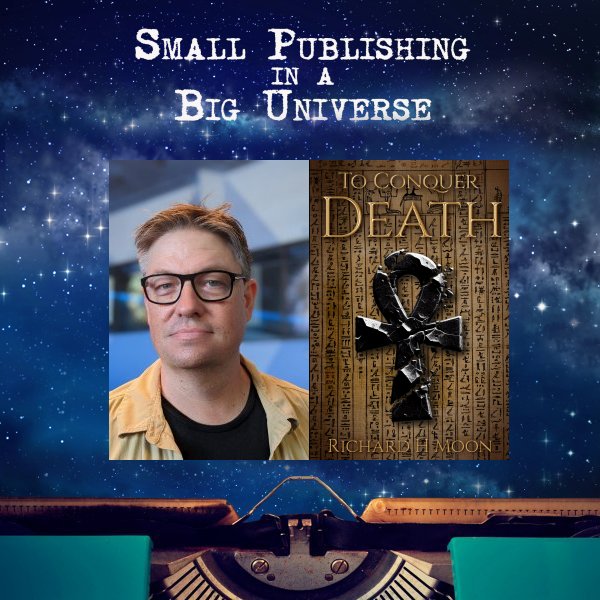
[00:01:49] Speaker A: Is Richard H. Moon. I'm a screenwriter, producer and a novelist.
[00:01:53] Speaker C: Now, it's your first book, right?
[00:01:55] Speaker A: Yes. Yeah. This is the first book that I've gotten published. Yeah. To Conquer Death is a historical fantasy adventure set in ancient Egypt about two Egyptian brothers and two barbarian European women who have to come together during an era known as the Bronze Age Collapse to overcome their trauma and go on an adventure to figure out what's causing the ancient civilizations of the world to fall apart. And what they find is that it's a uprising of the undead.
[00:02:22] Speaker C: Why did you write this book?
[00:02:26] Speaker A: I read a lot and I watch a lot of stuff. I'm just one of those people that's kind of constantly looking for the next thing that kind of interests me. And there was this period in history called the Bronze Age Collapse, which happened about 1200 BC or so, and a whole set of migrations and wars and droughts and climate change basically wiped out all of the civilizations of the ancient world around the eastern Mediterranean. The Mycenaean Greeks, the Hittites, the Assyrians, Babylon, all of their big empires fell apart except for ancient Egypt, but it still only had about 30 years left before it fell apart. And it's one of those events in history that we don't know a ton about because we only have a few written records from the Egyptians. We have a bit of archaeology from other places, but we don't have tons of writing about it. So there's a big mystery as to what caused some of these Migrations, where these people came from, what everything happened. And several years ago I was reading about that and I started to think, well, what invasions weren't invasions like people coming down to conquer, but they were migrations, they were people fleeing. And these weren't necessarily invaders, they were refugees. And what would be something that could cause them to want to run away from where they had been in nomadic Europe, sweep across the Mediterranean? Then I started developing that idea. For a long time, it kind of sat as a setting more than a story. And then I did wind up writing a treatment as if it was going to be a feature film, because at the time I was in production and screenwriting production primarily. And then when 2020 came around and Covid hit and everything locked down, it actually wiped out this one film production that we'd been trying to get set up for years that was basically killing me slowly. And I had a moment where I was like, oh, I don't have to make this movie anymore. And I realized I hadn't written anything for myself in about four years at that point. So I really refocused on the writing, churned out two spec scripts over the course of the summer, and then was looking at this treatment and I thought, well, I should work on this, except this is way too big to be a feature film.
There's no way I can cut this down. So it'll be 120 page script, and it's also set in ancient Egypt and kind of big. There's no way I could ever get a budget together to make this sort of thing. And it had been a couple of decades by that point since I had really tried to write books and prose. And I was like, well, what if I just expand this? What if I just look at this as a book? And it just started pouring out of me in that style. And I was like, oh, okay, this is how this story needed to be told.
Why did I write this book? Because it wouldn't leave me alone until I got it out on the page. And yeah, it similarly wouldn't leave me alone until I got it into publishable form and really got it out into the world.
[00:05:00] Speaker C: What got you into such ancient history?
[00:05:03] Speaker A: I've always been a voracious reader of a bunch of different things, and I like ancient history. But over the last decade, I've found myself really being attracted towards fantasy in particular. That's not in the medieval, especially like medieval England mold, because so much fantasy is just right there. And I grew up playing D and D. I'm a guy who's read the Silmarillion several times. So I like my medieval fantasy, but at the same time I wanted more and more fantasy that didn't look like what I'd read before. And the world that was in was something I could recognize. Not necessarily completely fantastical world, but was telling different sorts of stories. And one book in particular that opened my eyes was the speaker for the Dead series Blood and Obsidian by Olet de Bodard, which is all set in pre Columbian Mexico, and the main character is the high priest for the God of the dead in Tenochtitlan. And I was like, oh, this is great. This is the world is real, Magic is within, that world is real, and it's nothing that I've seen before.
At the same time, this is a society that's not what I'm familiar with. And reading that book, that was actually before I started really developing this story, I was like, oh, that's the kind of story I want to tell. That's the sort of story I want to read more of. So that really inspired me and drove me in this direction.
[00:06:21] Speaker C: What do you do for a real job?
[00:06:24] Speaker A: Several things. At one point I told a kid I was tutoring that I had about six jobs at that time and I'm cut down a little bit. But I have a whole set of other jobs. But my main focus is I'm actually a screenwriter and I work as a development producer with Voyage Media, helping them kind of shepherd projects through an initial author having a property that they wanted to get adapted and helping them adapt them into screenplays for feature films, for television series, and primarily now podcasts. So we're just one project that I'm attached to with Voyage just wrapped production on the the acting side of things, and now I'm waiting for the editor to get an assembly together on a podcast. That's going to be a lot of fun, and I'm looking forward to talking more about that once it's in more complete state. But really, I get to spend most of my time working on story, working with other people on their stories, and that's my primary job.
Outside of that, I work with the City of Hope Cancer Hospital with their iacuc, the Institutional Animal Care and Use Committee.
[00:07:28] Speaker C: Does that influence your writing?
[00:07:31] Speaker A: Not in a way that I would say directly other than everything kind of influences my writing in a lot of ways. My writing tends to focus on how we approach death and grief and forgiveness.
[00:07:46] Speaker C: Did you self publish or is it a hybrid publisher?
[00:07:50] Speaker A: It's a hybrid publisher. So yeah, I hooked up with Atmosphere Press earlier this year. And they were almost precisely what I didn't realize I had been looking for. Because I had been thinking about self publishing. I'd been querying agents a little bit. I used to have an agent, but he unfortunately passed away in 2021. So I'd been querying literary agents with the book for a while, but also not 100% seriously. I was kind of trying to figure out which way I wanted to go. And I went to the conference in downtown Los Angeles that was the association of Writers and Writing Programs, the AWP conference. Going to see what information I would get there. That's and encountered Atmosphere and a couple other hybrid publishers and was like, oh, this is what I wanted. Because I wanted the control and reliance of self publishing. But at the same time, I've produced independent films and I know the difficulty of putting together a good team. I was like, I don't know cover artists. Where am I going to find good cover artists? I don't know line editors. Where am I going to get a good line edit? Because I didn't want to just throw it out into the world. Although the people who do self publish, more power to them. I constantly amaze that some of my favorite books are self published. But at the same time I was like, I know where my skill set ends and it was going to be in finding the right people.
So with Atmosphere, it fit that need that I didn't realize I had. And they were actually able to put together the team that would get me the right sort of COVID art, the right sort of development edit, the right sort of line edit, the right sort of publicity plan. And I had enough money to pay for all that. And I've been thinking about self publishing and I was going to pay for all of that anyway. I might as well pay for a good team. And they have been an excellent team. They have been so amazingly supportive and. And not just supportive, but really propulsive that they have gotten the book to reviewers that again, I wouldn't have even had any idea how to get it to reviews. It got a great review from Kirkus. As soon as I saw that, I was like, it says right there, it says our verdict. Get it. I'm like, that's, you know, it's Kirkus. I know that much. It's amazing. I've been really blessed to have hooked up with them.
[00:09:56] Speaker C: Is it about the love of the.
[00:09:57] Speaker B: Craft and the love of the story?
[00:09:59] Speaker A: I would almost say there's a slightly pathological end to it because I've joked only barely A joke that when people say, well, what keeps you writing? How do you keep writing? And I'm like, I've tried not doing it and I couldn't hack that. Just couldn't hack it at all. It's one of those things where if I had no possibility of making any money at all, I'd still be writing. And I mean, that's what being a screenwriter who's writing spec scripts is about. I have stories. The stories need to get out. Am I going to get this story made? I don't know. Maybe yes, possibly no. If there was no money at all in this, I'd still be writing stories, I'd still be putting stuff together. I've tried not doing it, couldn't hack that. I still come up with stories, I'm still having to write them down. I'm still trying to figure out how to get other people to have the same emotional experience with these ideas that I'm having.
My biggest piece of advice for new writers is twofold. It's one, don't worry about marketplace and trends and what's selling and what's not selling. No, don't. That will just drive you insane and kill your actual creativity. You have to tell the stories that you want to tell. And fundamentally, if you're interested in a story, that means there is at least one person in the world that will be an audience for that story, and that's you. And if there's one person, then there's more. There's audience out there for every sort of story. So don't worry about trying to chase whatever is selling or whatever is popular. Tell the stories you want to tell. If that is in that shape of something that's popular, more power to you, great. But you have to be passionate about it. It has to be something you want to read or see or what. Whatever. It has to be coming from you. Because if it's not burning to get out of you, then it's not going to be that interesting to anyone else either. And the other bit of advice that I think is critical, and it took me an embarrassing long time to figure out, is that sometimes in order to write, you need to not write. You need to get away from the keyboard, you need to go do something else. You need to let your brain not be staring at a blank page or a page with a half finished sentence. You need to go do other stuff because that's when your brain will figure out the questions that you can't answer. Anytime you're sitting at a keyboard and are stuck, I don't believe in writer's block. I think writer's block is simply you haven't figured out the answers to a question that you maybe haven't asked yourself yet, that you don't even know is a question yet. But I have had for myself enough times where I've stared at that page and stared at that page and it just doesn't come together. And I've written a sentence and deleted the sentence and written another sentence and deleted it. It's not coming together. And the instant I get up and I go and I do something else, even as simple as going for a walk, that's when things start to come together. That's when you're not trying to force the creativity and you're letting the creativity just happen. Because functionally, if you've read and enjoyed a book, then you know what a story looks like, even if you can't consciously break it down. Your subconscious knows what that story felt like and will help you figure out how your story is supposed to go. You just got to let it get out of your own way.
[00:12:58] Speaker C: Where can people contact you?
[00:13:00] Speaker A: Two major places are if you want to know more about the book, you can go to my website, which is just richardmoonbooks.com that has all the information about this book and future books that I'm currently working on as well. And it's also going to have all these podcasts I'm on and you can contact me through there. The other place is voyagemedia.com I'm one of the producers that you can select. If you have a project that you want to pitch as potentially getting developed there, you can find me there. Find the one that you feel will best match whatever story you want to develop. While I'm on Instagram and Facebook, I'm kind of barely on those and I'm mostly on Blue sky. If you look up my name on blue sky, it'll pop up.
[00:13:45] Speaker B: A ghost of you by Savannah Giles Two months in a jukebox ago, she met a man in a tie dye shirt who was rough around the edges to say the least.
Somewhere between the steamy nights and sweet nothings, she got lost in him. Fast forward to today. Imagine her surprise to see the same man on the news for being one of the world's most dangerous men. Now that she knows who he is and what he's done, her little secret is going to be harder to keep. Because now all she has left is a ghost of him. A Ghost of youf by Savannah Giles is available in hardcover, paperback and ebook editions support your local bookstore by ordering it through bookshop.org.
[00:14:36] Speaker C: Thanks again to our guest. We plan on publishing a new episode every month. If you want to know more about small publishing in a big universe, visit our
[email protected] and subscribe to our newsletter. Send us your feedback by using the Contact Us link Like Us on Facebook @SPBUpodcast. To find out more about the books and other products featured during this episode, please visit the Small Publishing in a Big Universe
[email protected] this podcast was recorded and edited by Lisa Jacob. Executive Producer is Stephen Radecki. Theme and ad music is provided by Melody Loops. This month's episode was sponsored by Cupid's Arrow Publishing and Paper Angel Press. You can listen to our podcast on Apple Podcast, Spotify, Amazon Music, and most of your favorite podcast services.
Thank you very much for listening and see you next month.